PURSUE Flags An Apollo 17 Frame
The Department of War's May 8, 2026 PURSUE Release 01 metadata identifies NASA-UAP-VM6 as a NASA image record tied to Apollo 17, 1972, with the Moon as the incident location and a hosted JPEG as the released visual asset.123
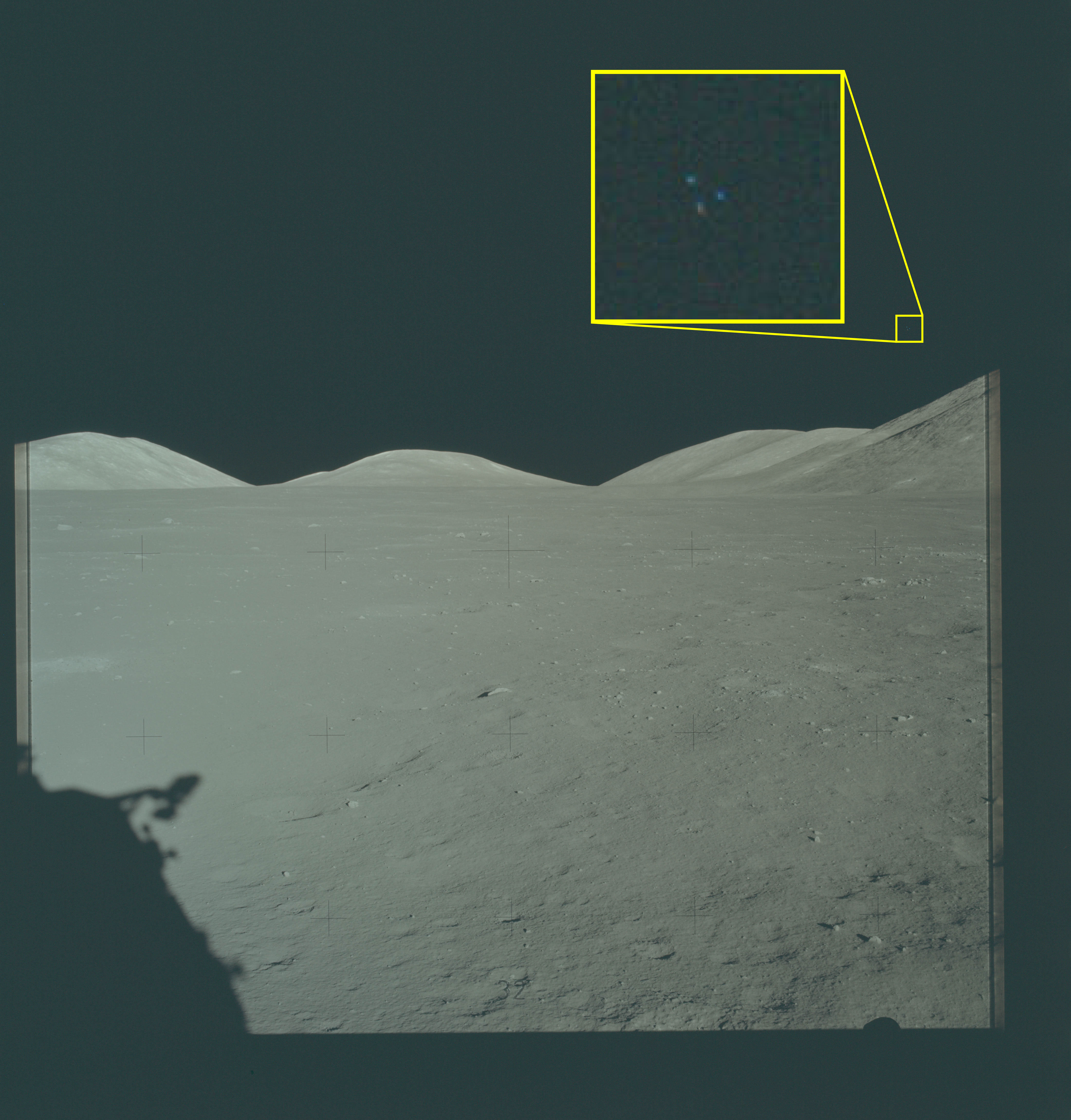
The release description says the Department of War opened a case to investigate an accompanying NASA photograph from the December 1972 Apollo 17 mission. It describes three dots in a triangular formation in the lower-right quadrant of the lunar sky, visible on magnification, and says there is no consensus about the nature of the anomaly.2 The same description says preliminary U.S. government analysis suggests the feature may be the result of a physical object in the scene, while also stating that the original Apollo 17 film has been obtained and that full NASA and Department of War analysis will be released when completed.2
The Likely NASA Source Frame
Apollo 17 was NASA's final Apollo lunar landing mission. NASA identifies the crew as Eugene A. Cernan, Harrison H. Schmitt, and Ronald E. Evans; the mission launched on December 7, 1972, landed at Taurus-Littrow on December 11, and returned to Earth on December 19.45
The released image matches NASA photo ID AS17-147-22470 in subject and framing. NASA's Johnson Space Center catalog identifies AS17-147-22470 as an astronaut photograph of Earth's Moon surface at Taurus-Littrow Valley.6 NASA's Apollo 17 photographic index lists frame 147-22470 as a 70 mm Hasselblad photograph from Magazine A, film SO-368, taken with a 60 mm lens before EVA 1 as an LM window panorama.7 NASA's Apollo Lunar Surface Journal discussion of Family Mountain also places AS17-147-22470 as a view out Jack Schmitt's lunar module window shortly after touchdown.8
Three Points In The Lunar Sky
The Department of War JPEG shows a lunar surface view beneath a dark sky, with hills along the horizon, camera registration marks across the frame, and a shadowed lunar module or window edge intruding at lower left.3 A yellow callout marks a small area in the lower-right sky and enlarges it near the top of the image, where three small blue-white points appear in a triangular arrangement.3
The visible image supports a narrow claim: a released Apollo 17 visual-media record contains three highlighted points of light in the lunar sky, and the 2026 release presents those points as an unresolved feature under investigation.23 The image alone does not establish the points' distance, scale, altitude, motion, physical shape, or relationship to Apollo spacecraft hardware. Because the source frame is an LM window panorama, the public JPEG also cannot rule out optical reflection, film, scanning, compression, or annotation-related effects without the original film and a technical comparison to adjacent frames.278
A Traceable But Unresolved Record
NASA-UAP-VM6 matters because it is a modern UAP release attached to a traceable Apollo photographic record. The strongest public evidence is not a conclusion about an extraordinary object; it is the chain of provenance from PURSUE metadata, to the Department of War annotated image, to a likely NASA Apollo 17 source frame.236
The record should therefore be read as an open investigative item. The Department of War says there is no consensus and that further NASA and Department of War analysis is pending.2 Until that analysis is public, the responsible interpretation is limited: the image identifies a real visual feature in an Apollo 17 photograph, but does not by itself identify what caused it.