The Department of War's PURSUE Release 01 identifies NASA-UAP-VM5 as a NASA image record titled "NASA-UAP-VM5, Apollo 12, 1969," released on May 8, 2026, with 1969 as the incident date and the Moon as the incident location.12 Its media field points to a hosted JPEG, not a PDF or video, and the public metadata does not provide a NASA frame number, camera magazine, exposure data, scan history, or unannotated source frame.23
Apollo 12 Lunar Photography
Apollo 12 was NASA's second crewed lunar landing mission, flown by Charles Conrad Jr., Alan L. Bean, and Richard F. Gordon Jr. after launch on November 14, 1969 and splashdown on November 24, 1969.4 NASA's mission account places the Lunar Module Intrepid in the Ocean of Storms, about 535 feet from Surveyor III, and describes Conrad and Bean photographing experiment equipment, the spacecraft, lunar terrain, and themselves during the first surface EVA.5
That context matters because the PURSUE record applies a 2026 UAP-review label to Apollo-era NASA visual media rather than documenting a new observation made in 2026.12 NASA's Apollo 12 image library preserves mission surface photography by magazine and frame group, but the PURSUE row does not identify which original Apollo frame corresponds to NASA-UAP-VM5.26
Five Marked Horizon Areas
The release metadata describes the asset as an archival photograph of the lunar surface viewed from the Apollo 12 landing site.2 It says the published image marks five areas of interest, labeled Area 1 through Area 5, above the lunar horizon, where unidentified phenomena are visible.2
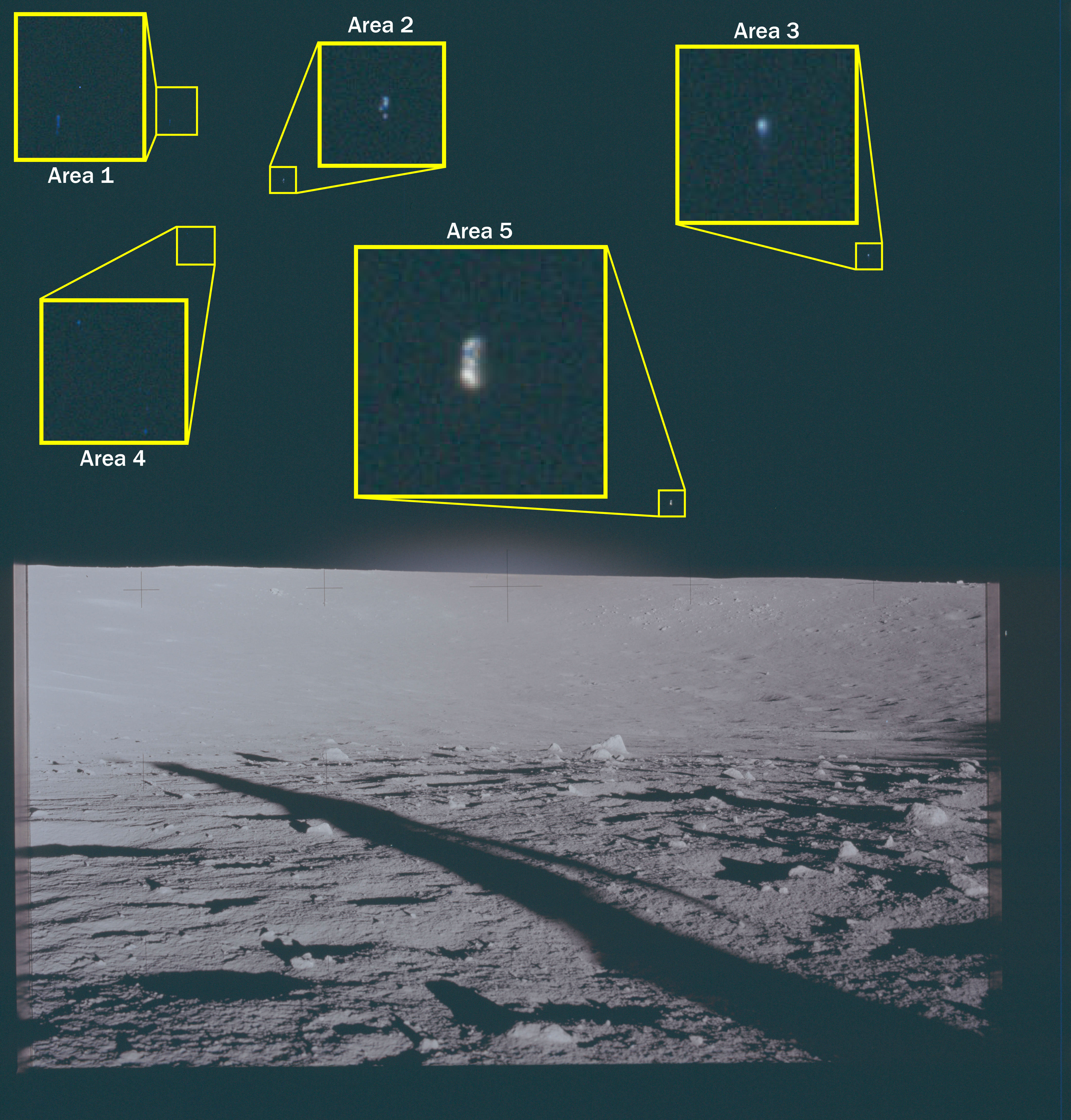
The visible release asset supports a limited claim: the Department of War published an annotated Apollo 12 lunar-surface view and directed attention to five small above-horizon regions.23 It does not establish the distance, size, altitude, motion, source, or physical nature of the marked features, and it cannot separate possible scene content from film, lens, scan, compression, or annotation effects without the original unmarked frame and adjacent mission imagery.236
Comparison Point, Not Conclusion
NASA-UAP-VM5 matters as a documented comparison point, not as a conclusion. It ties a specific Department of War release asset to Apollo 12 visual media and preserves the public claim that five above-horizon regions were highlighted for review.123 Its evidentiary value depends on future comparison with the corresponding original NASA photograph, neighboring frames, and scan provenance before any stronger interpretation is justified.26