The PURSUE Apollo 12 Entry
PURSUE Release 01 identifies NASA-UAP-VM4 as a NASA image record released on May 8, 2026, with 1969 as the incident year, the Moon as the location, and a Department of War media link for the hosted JPEG.12
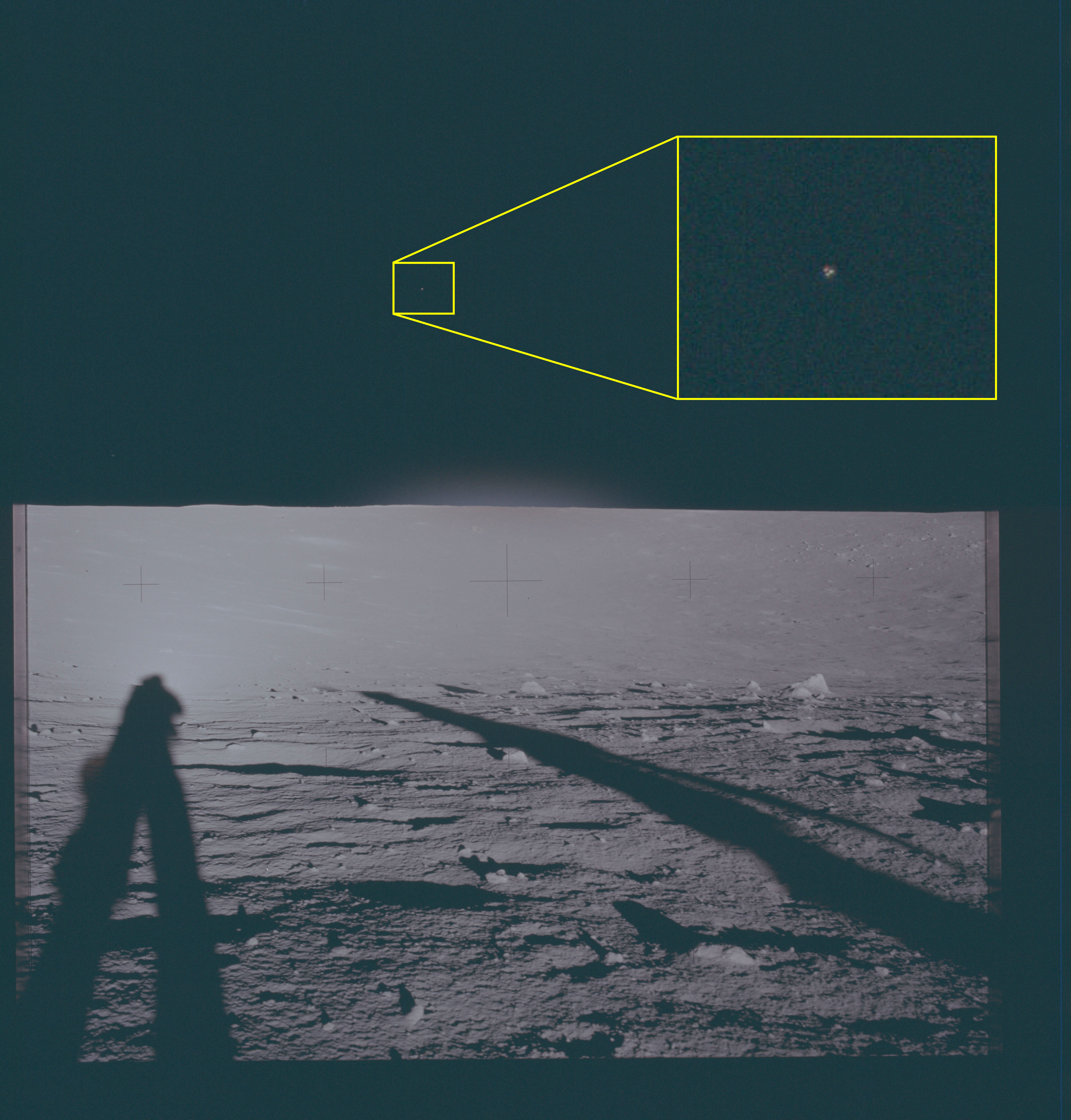
The release description presents the file as an archival Apollo 12 photograph of the lunar surface from the mission's landing site. It calls attention to one highlighted area slightly left of the frame's vertical axis, above the lunar horizon, where the release says unidentified phenomena are visible.1 The record also states that the image was modified to help viewers identify the area of interest and that those highlights do not, by themselves, make an analytical judgment or factual determination about the subject.1
Apollo 12's Photographic Mission
Apollo 12 was NASA's second crewed lunar landing. NASA lists the crew as Charles Conrad Jr., Alan L. Bean, and Richard F. Gordon Jr., with launch on November 14, 1969, and splashdown on November 24, 1969.3 NASA's mission history describes the landing as a precision touchdown in the Ocean of Storms, near the Surveyor III spacecraft.4
Photography was an ordinary part of Apollo 12's mission record, not a later addition to the flight. The Apollo 12 mission report lists lunar surface, crew activity, experiment-equipment, surface-environment, panoramic, stereo, and Surveyor III photography among the mission's photographic objectives.5 NASA's mission history also notes that Conrad and Bean photographed equipment, the spacecraft, lunar terrain, and themselves during surface operations.4
Limits Of The Annotated JPEG
The image supports a narrow claim: the 2026 Department of War release presented an Apollo 12 lunar-surface photograph with a highlighted sky area above the horizon, slightly left of center.12 The release record does not establish the feature's distance, size, altitude, motion, original frame number, or physical nature. A single annotated JPEG also cannot rule out film, scanning, compression, optical, or annotation-related causes.
That limitation is the point of preserving the record carefully. NASA-UAP-VM4 matters because it shows how PURSUE Release 01 framed one Apollo-era visual media item as UAP-relevant while leaving the evidentiary boundary intact: an official release record, an Apollo 12 mission source context, and an annotated image that would require original-film provenance and technical image analysis before stronger conclusions could be drawn.15