The Department of War's May 8, 2026 PURSUE Release 01 metadata identifies NASA-UAP-VM2 as a NASA image titled NASA-UAP-VM2, Apollo 12, 1969, with Moon as the incident location and 1969 as the incident year.12 The record points to a remote JPG released through the Department of War media archive.3 The broader PURSUE page describes the release collection as unresolved material, meaning the government has not made a definitive determination about the observed phenomena.1
Apollo 12 Image Trail
Apollo 12 launched on November 14, 1969, carried Charles Conrad Jr., Alan L. Bean, and Richard F. Gordon Jr., and returned on November 24 after completing NASA's second crewed lunar landing mission.4 NASA's mission account describes the landing as a precision touchdown by the Lunar Module Intrepid in the Ocean of Storms, roughly 535 feet from Surveyor III.5 That matters for this record because the PURSUE title and caption place the image in Apollo 12 lunar-surface photography rather than in a later reconstruction or witness retelling.2
NASA's Apollo 12 Image Library documents the mission's lunar-surface photographs as astronaut-taken images and notes that high-resolution versions of many surface frames are available in the archive.6 The PURSUE metadata, however, does not supply the original NASA frame number, camera magazine, exposure data, scan history, or an unannotated comparison frame for NASA-UAP-VM2.2
Two Marked Lunar Areas
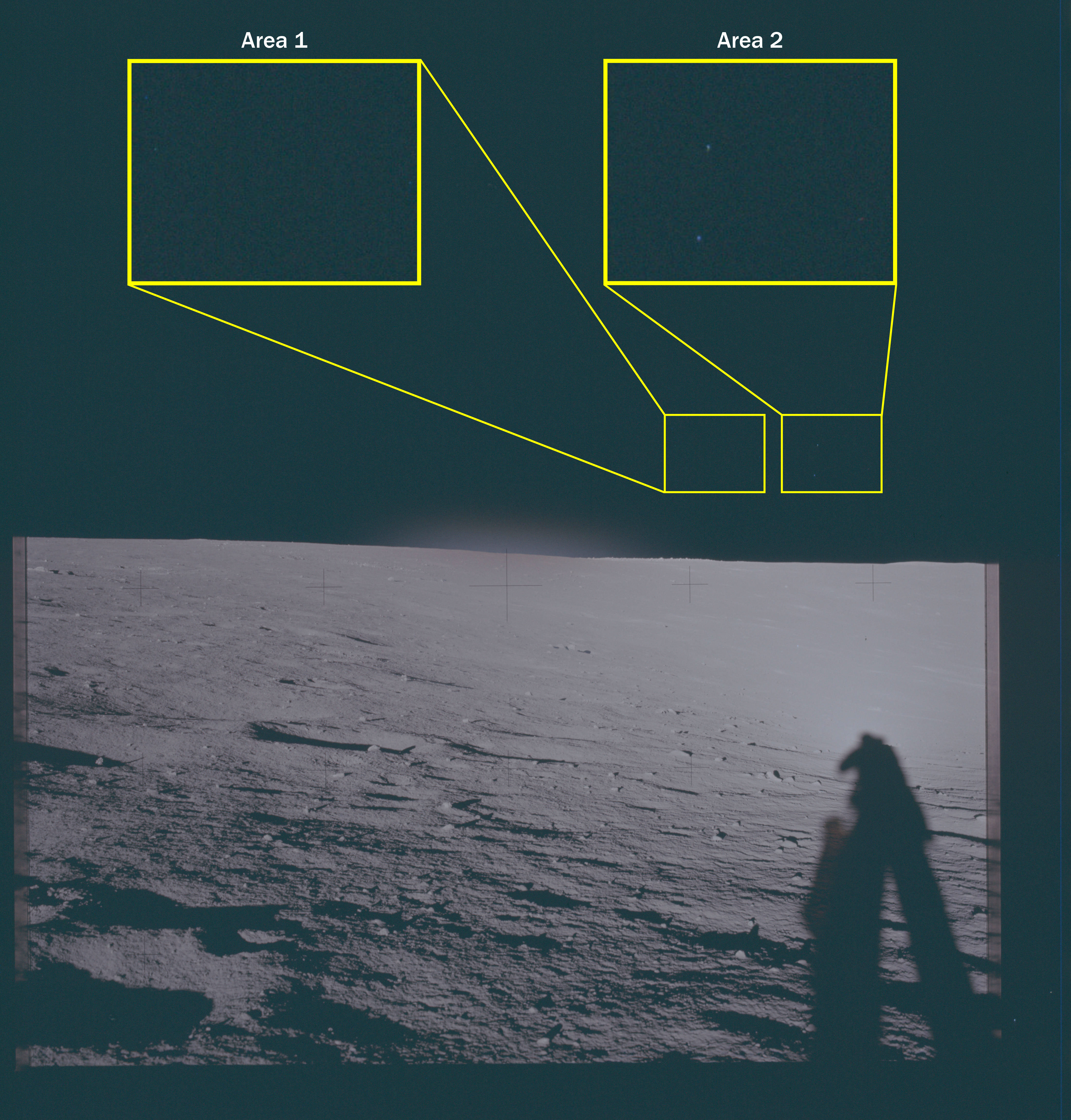
The Department of War release metadata describes the asset as an archival photograph of the lunar surface viewed from the Apollo 12 landing site. It says the released image marks two areas of interest, labeled Area 1 and Area 2, slightly right of the frame's vertical axis and above the horizon, where unidentified phenomena are visible.2 The same metadata says the image was modified from its original state to help viewers locate specific areas, and that the highlights are contextual rather than an analytical judgment, investigative conclusion, or factual determination.2
What VM2 Cannot Show
The visible release image can support a narrow claim: the published asset is an annotated Apollo 12 lunar-surface image, and the annotations direct attention to two small above-horizon regions.23 It cannot establish the size, distance, speed, trajectory, physical nature, or origin of whatever appears inside those highlighted areas. Without the original unmarked NASA frame, adjacent sequence frames, camera orientation, exposure information, and scan provenance, the image alone cannot distinguish among external objects, dust, film or lens blemishes, scanning artifacts, processing marks, or compression effects.
A Starting Point for Frame Matching
NASA-UAP-VM2 is useful because it ties a specific visual-media release asset to a specific Apollo mission, while preserving the limits of what the public record actually shows. Its value is not that it proves an anomalous craft; it is a documented starting point for comparing the Department of War's annotated image with NASA's original Apollo photographic record if a matching source frame or higher-quality unannotated version is identified.236