Department of War PURSUE Release 01 identifies FBI Photo A3 as an FBI image release dated May 8, 2026, with the incident date listed as late 2025 and the incident location not provided.1 The release describes the record as a still image from a U.S. government system submitted by the Federal Bureau of Investigation to the All-domain Anomaly Resolution Office as part of a UAP report.1
The release record says the original imagery was altered with redactions before submission to AARO, that no accompanying mission report was provided, and that the operator reported being unable to positively identify the UAP.1 Those statements are important because they define the public record: this is not a full case file or an analytical finding, but a redacted image entry with limited accompanying context.
Reticle-Centered Image
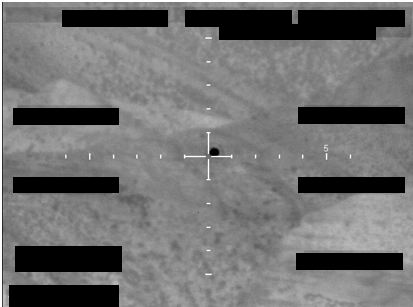
The released frame is monochrome and heavily redacted, with black bars obscuring portions of the display around the image area. A central crosshair reticle sits over a mottled, textured background, and a dark circular mark appears at the center of the reticle. The Department of War narrative describes the background as possibly depicting ground terrain and labels the description as informational rather than an investigative conclusion.1
Missing Technical Context
The public image does not establish the source platform, sensor type, altitude, range, scale, location, exact date, motion, speed, or behavior of the dark mark. Because the record lacks a mission report and the image is a single redacted frame, it cannot by itself show whether the mark is a distant object, a surface feature, an imaging artifact, or something else. The strongest supportable reading is narrower: the FBI submitted a redacted government-system still image to AARO, and the operator reported that the UAP could not be positively identified.1
Useful, but Narrow
FBI Photo A3 matters because it separates an evidentiary artifact from the interpretation people may want to place on it. The image shows what was released: a reticle-centered dark circular mark in a redacted monochrome frame. The metadata shows what is missing: date and location details, a mission report, and enough technical context to evaluate scale or motion. That combination makes the record useful as a cataloged release item, but weak as standalone proof of origin, performance, or anomalous behavior.12